


Featured Lendület Researcher: Boldizsár Szentgáli-Tóth
Artificial intelligence (AI) is making its presence felt in every aspect of life, and this trend is only expected to accelerate in the future. The legal profession is no exception, though alongside new opportunities, AI may also entail significant risks. For this reason, the legal profession must prepare now for the challenges posed by AI. This goal underpins the research conducted by Boldizsár Szentgáli-Tóth, senior research fellow at the Institute for Legal Studies of the ELTE Centre for Social Sciences, researcher at the National University of Public Service, and adjunct lecturer at Eötvös Loránd University, together with his colleagues. Their work has received support through the Lendület (Momentum) Programme.
Modern technology, and AI in particular, which has been developing at breakneck speed in recent years, is playing an increasingly significant role in our daily lives, as well as in science, the economy, healthcare and education – practically in every domain of human activity.
Creating flexible frameworks
Social life and legal relationships are no exception to this, but legislation and legal practice are not always able to keep pace with these rapid changes. “The law is a relatively conservative system of rules that is slow to change. In contrast, today’s social reality is changing extremely rapidly and is highly dynamic. These are challenges to which we must respond by creating flexible frameworks,” said Szentgáli-Tóth, head of the Momentum research group on Perspectives and Limits of Algorithmic Constitutionalism. “We can try to apply our existing legal concepts to emerging new legal relationships, but this alone does not necessarily lead to the right outcome.
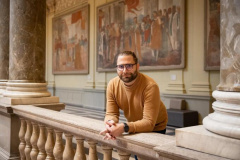
 Boldizsár Szentgáli-Tóth Photo: mta.hu / Tamás Szigeti
 Therefore, we must also seek innovative tools that ensure new technological conditions do not alter our daily lives and that the protection of human rights is not compromised.”
The researchers of this Momentum group are contributing to this work primarily by applying the tools of constitutional law. The research group leader explained that as the world faces new challenges, both the focus of constitutional law and the discourse surrounding the field evolve accordingly. In recent years, for example, the researchers have also examined the challenges posed to human rights by the public health crisis arising from COVID-19 and the wider pandemic, as well as the possible legal responses available within this special legal framework.
It is therefore legitimate to ask what direct or indirect impact AI – and modern technology more broadly – may have on constitutionalism, the legal system, legal practice and human rights. “In some countries, artificial intelligence is already present in courtrooms, and it may soon appear in parliaments as well, where it could perform a wide range of functions,” continued Szentgáli-Tóth. “AI can, for example, prepare transcripts of hearings or parliamentary sessions, and can also produce drafts of legal documents. It is quite possible that lawyers will soon be using generative AI applications to draft documents, while judges themselves may consult artificial intelligence regarding the substance and wording of judicial decisions.”
The issue of legal certainty always arises when using AI, whether in healthcare, elderly care, or online communication.
AI can easily create fake profiles, which it can then use to post comments on social media. This brings to the fore issues related to privacy rights, freedom of speech, and the protection of personal data. The results of last year’s presidential election in Romania were annulled due to such forms of manipulation, meaning that the right to vote and the entire democratic institutional system could be compromised.
Three Responses from the Legal System
The impact of artificial intelligence on the legal system is not necessarily negative, as it can also facilitate the effective and fair administration of justice. AI can help predict likely developments and can also help in terms of a more effective allocation of resources. However, for these positive effects to prevail, the legal system must adapt to changing conditions. The law can essentially provide three types of responses to these new challenges: normative regulations can be changed, meaning new legislation can be adopted; non-binding legal norms can also be created (the so-called “soft law” approach); and changes in judicial practice can also be used to respond to the altered circumstances. In the first area, steps have already been taken, as the European Union has adopted an AI Act that seeks to regulate emerging issues through normative means, which will then need to be transposed at the national level.
The researcher noted that we are also in relatively good shape in the realm of soft law, as numerous non-binding international agreements, guidelines, and national strategies have already been developed in recent years regarding artificial intelligence. Where truly significant progress is needed is in the areas of case law and judicial interpretation, as here even the application of existing regulations from new perspectives could effectively address the issues that arise. During the first phase of the Momentum project, the research team is collecting as much data as possible on the legal documents and norms that exist in various countries and international organisations regarding the relationship between artificial intelligence and fundamental rights, as well as on the judicial responses different legal systems have developed thus far in addressing these issues.
They focus on three areas in particular:
the right to freedom of expression, the right to a fair trial, and the right to a healthy environment.
They examine the results of tests conducted so far regarding the integration of AI into judicial practice, as well as how to develop responses using legal instruments to ensure adequate protection of human rights in this new era.
According to the research group leader, AI has now become part of our lives, so we should no longer focus on whether its effects are positive or negative, or whether its expansion should be permitted on that basis. Instead, we should concentrate on how we can best coexist with it. “We could ban AI, but that would only result in it finding its way into the system through various indirect channels.
Artificial intelligence is neither good nor bad; rather, it has certain capabilities and characteristics which, if we learn to work with them effectively, can help us in many ways,”
says the constitutional lawyer. “There have been many occasions throughout human history when a new invention or technological discovery emerged, was tested, and then was gradually integrated into daily life. The same thing happened when railroads and various machines appeared during the Industrial Revolution: at first they seemed dangerous and alien, but later they found their place in the world.”
AI’s Tendency Towards Discrimination
In legal practice, according to the researcher, there are numerous repetitive, time-consuming, and labour-intensive processes in which AI could prove very useful (such as drafting records or reviewing massive legal databases). At the same time, the added value of human lawyers remains indispensable. Any documents drafted by AI must always be reviewed by a lawyer; otherwise, we could face very damaging consequences.
Since AI fundamentally makes decisions on a statistical basis, it is highly prone to discrimination, which is an issue requiring special attention in legal practice. In this sense, it is a myth that AI can render more objective judgements than humans, who are unable to free themselves from their biases. If the algorithm determines that the proportion of offenders is higher among certain social groups, it will be more likely to issue a guilty verdict for individuals from that community, regardless of the specific context. In addition, we must prevent people with better digital skills from gaining an unfair advantage in legal proceedings that utilise AI and other electronic tools. “Those who, for whatever reason, have not received technical training or do not have the appropriate tools are at a very serious disadvantage,” said Szentgáli-Tóth. “So there are both advantages and disadvantages. Our task is to identify the tools that allow us to capitalise on the advantages while at the same time eliminating the disadvantages as much as possible, or at least keeping them within manageable limits.”
A témához kapcsolódó cikkeink

Featured Lendület Researcher: Szilvia Zita Tóth
Szilvia Zita Tóth, Director of the Institute of Plant Biology at the HUN-REN Biological Research Centre in Szeged and Head of the Laboratory for Molecular Photobioenergetics, is now conducting research on the hydrogen-producing capacity of green algae in her second Momentum (Lendület) grant project. This capacity may be harnessed for human energy generation in the future. In the long term, it may even become possible to utilise the direct electrical current production of algae. This would enable energy to be generated without the emission of greenhouse gases, while the algae would also absorb carbon dioxide through photosynthesis. In addition, the biomass of the algae could also be utilised.
_680_454_1773830811_fill_240x160.jpg)
Featured Lendület Researcher: Balázs Reizer
Hungarian workers still earn significantly less than their Western counterparts. In order for this situation to change, it is essential to uncover the underlying causes of this phenomenon. This is the task undertaken by Balázs Reizer, Senior Research Fellow at the ELTE Centre for Economic and Regional Studies and Head of the Momentum Technology and Inequality Research Group, together with his colleagues. With his team, he is investigating what Hungarian workers actually do during their working hours and how the innovative transformation and robotisation of production affect workers in different job roles.

Featured Lendület Researcher: Péter Pál Pach
Péter Pál Pach, Senior Research Fellow at the Alfréd Rényi Institute of Mathematics and Head of the MTA–HUN–REN RI Momentum (Lendület) Arithmetic Combinatorics Research Group, continues his research work. Together with his co-authors, he was awarded the Frontiers of Science Award in 2024 for their 2016 paper, in which they developed a new version of the polynomial method. The research group’s work focuses on fundamental research in the field of arithmetic combinatorics. However, this field has numerous connections to other branches of mathematics, so the research group’s results will also be of use to mathematicians researching many other problems.
Featured Lendület Researcher: Ádám Lovas-Kiss
Waterbirds play a much more important role in the dispersal of aquatic plants, and even of invertebrate animals, than was previously assumed, as they consume reproductive seeds and other propagules and then excrete them in another small pond. Ádám Lovas-Kiss, research fellow at the Institute of Aquatic Ecology of the HUN–REN Centre for Ecological Research and head of the Momentum Dispersal Ecology Research Group, is studying this process with the support of the Momentum Programme. The importance of his research is further increased by the fact that climate change is causing more and more wetlands to disappear and the condition of aquatic communities to deteriorate.
_680_454_1764597338_fill_240x160.jpg)
Featured Lendület Researcher: Edit Mátyus
Although quantum electrodynamics is considered a well-established theory in physics, in chemistry – in the world of atoms and molecules – it still raises a number of unresolved questions. Edit Mátyus, Doctor of the Hungarian Academy of Sciences, Professor in the Department of Physical Chemistry at Eötvös Loránd University, and head of the Molecular Quantum Electrodynamics Research Group, and her colleagues are attempting to answer these questions with the support of the Momentum Programme.

Featured Lendület Researcher: Péter Nemes-Incze
Often, the simplest models are needed to understand the most complex laws of nature. This is especially true for interacting electron systems, about which we still know relatively little today because, until now, we have not had access to sufficiently simple model crystals. Despite this, Péter Nemes-Incze, head of the Momentum Topology in Nanostructures Research Group at the Institute of Technical Physics and Materials Science of the HUN–REN Centre for Energy Research, and his colleagues believe that this model could be rhombohedral graphite, which they are investigating with the support of their Momentum grant.
Featured Lendület Researcher: Balázs Lengyel
Nowadays, telecommunications providers and IT companies collect vast amounts of electronic data about us. These databases may contain sensitive personal data, which means they also carry risks, but at the same time they can be an incredibly valuable source of information for the social sciences. Balázs Lengyel, Senior Research Fellow at the Institute of Economics of the HUN-REN Centre for Economic and Regional Studies, and his colleagues are analysing some of this data with the support of the Momentum (Lendület) Programme. The researcher has won a Momentum grant for the second time – now in the advanced category – and is currently researching innovation and inequality in dynamic urban networks.

Featured Lendület Researcher: Tekla Etelka Gráczi
Various neurological diseases and conditions often affect a person’s speech. Tekla Etelka Gráczi, Senior Research Fellow at the HUN-REN Research Centre for Linguistics’ Institute for General and Hungarian Linguistics, and her Momentum research group are investigating this effect in subjects with Parkinson’s disease, Down syndrome and multiple sclerosis. Their research examines the acoustic characteristics of spoken sounds and the mechanism of sound production.

Featured Lendület Researcher: Réka Lukács
Réka Lukács, Senior Research Fellow at the Institute for Geological and Geochemical Research of the HUN-REN Research Centre for Astronomy and Earth Sciences is researching fundamental questions in volcanology with her team, with the support of the Momentum Programme. In addition to its scientific value, their research also has important practical and even disaster management implications, as hundreds of millions of people around the world live near dangerous volcanoes. It is therefore vital that we understand the workings of volcanoes as well as possible, so that our predictive models can become increasingly accurate.

Featured Lendület Researcher: Gergely Harcos
Automorphic forms play an important role in many areas of mathematics, including number theory, geometry, analysis and mathematical physics. Gergely Harcos, Research Professor at the HUN-REN Alfréd Rényi Institute of Mathematics and Head of the Momentum Automorph Research Group, is researching these automorphic forms with the support of the Momentum Programme. According to the researcher, the study of these mathematical objects could even bring us closer to one of the “holy grails” of mathematics, the proof of the Riemann hypothesis.