


Three Hungarian physicists awarded the 2027 Gregori Aminoff Prize by the Royal Swedish Academy of Sciences
Miklós Tegze, Gábor Bortel and Gyula Faigel have received the prestigious award for their outstanding achievements in the field of crystallography, marking the first time in the prize’s nearly half-century history that it has been awarded to Hungarian researchers.
Miklós Tegze, Gábor Bortel and Gyula Faigel, three researchers at the HUN–REN Wigner Research Centre for Physics, have been awarded the 2027 Gregori Aminoff Prize by the Royal Swedish Academy of Sciences. The three Hungarian physicists received one of the most prestigious international awards in crystallography for developing a novel, unprecedently super-rapid structure determination method.
Gábor Bortel is a senior research fellow in the Department of Experimental Solid-State Physics of the Institute for Solid State Physics and Optics at the Wigner Research Centre for Physics. Miklós Tegze, a Doctor of the Hungarian Academy of Sciences, and Gyula Faigel, a full member of the Hungarian Academy of Sciences, are both emeritus researchers in the department.
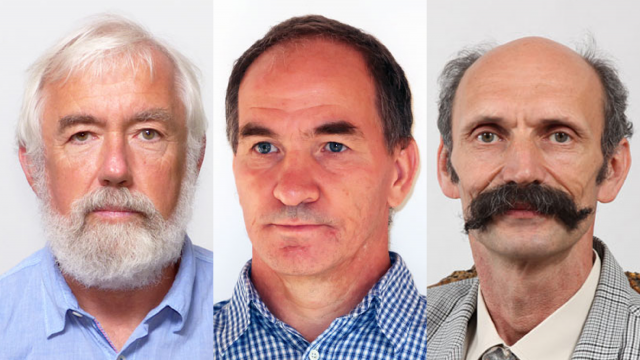 Miklós Tegze, Gábor Bortel, Gyula Faigel Photo: kva.se
According to an announcement made by the Royal Swedish Academy of Sciences on 16 September, ‘Kossel crystallography’ using an X-ray free-electron laser can determine the crystal structure of a given material in three dimensions at the atomic level, essentially using a single ultrafast X-ray pulse and Kossel lines, or X-ray diffraction patterns.
Previously, such structural analysis methods required multiple, more cumbersome measurements taken from several different angles, but the development of free-electron lasers, which produce very intense electromagnetic radiation in extremely short pulses, has opened up new possibilities for investigating the crystal structures of materials. Using the method developed by the award-winning Hungarian researchers, the three-dimensional crystal structure of a material can be determined from a single pulse lasting just 25 femtoseconds (one quadrillionth of a second).
The new method is not only suitable for examining the structure of material, but also for studying its rapid changes. It could therefore enable researchers to explore what happens when a material transforms from one state of matter to another, the Royal Swedish Academy of Sciences emphasised in its announcement.
Publication presenting Kossel crystallography: Bortel, G., Tegze, M., Sikorski, M. et al.: ‘3D atomic structure from a single X-ray free-electron laser pulse.’ Nature Communications 15, 970 (2024).
The prize, which carries an award of SEK 180,000, will be presented in spring 2027 at the Royal Swedish Academy of Sciences’ annual ceremonial meeting.
Named after a professor of mineralogy at the Swedish Museum of Natural History, the prize is one of the Royal Swedish Academy of Sciences’ most prestigious awards in the natural sciences, alongside the Nobel Prizes in Physics and Chemistry. Established in 1979, it is awarded to crystallographers who have achieved outstanding results in the study of the atomic structure of solid-state materials. In the nearly half-century history of the Gregori Aminoff Prize, Miklós Tegze, Gábor Bortel and Gyula Faigel are the first Hungarian researchers to receive this prestigious distinction.