


The Philosophy of Artificial Intelligence – Conference at the Hungarian Academy of Sciences
What dangers does artificial intelligence pose, and what impact does it have on education and science? These were the questions explored at the English-language conference Towards a Philosophy of Artificial Intelligence, held at the headquarters of the Hungarian Academy of Sciences. A recording of the conference can be viewed in this article.
In his welcome address, Mihály Pósfai, President of the Hungarian Academy of Sciences (MTA), spoke of how the conference reflected a genuine concern: what place will humans occupy in a world increasingly shaped by systems whose workings we ourselves may already find difficult to understand?
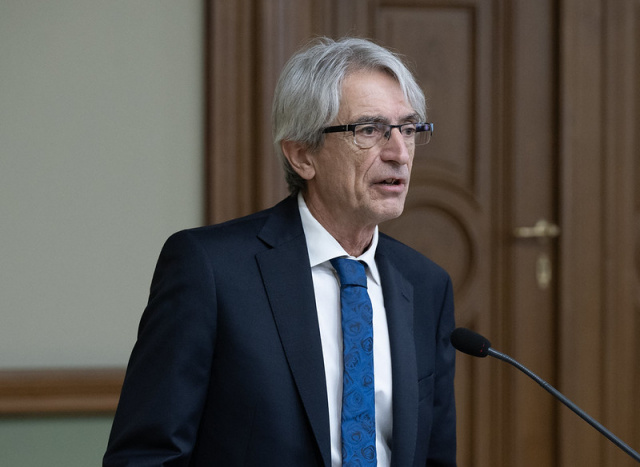 Mihály Pósfai Photo: mta.hu / Tamás Szigeti
“AI is part of a climate catastrophe of the mind. Education, particularly higher education, is on the verge of collapse. The scientific publishing industry is on the verge of collapse. Children’s mental health is on the verge of collapse. Is there a way out?” asked Kristóf Nyíri, the conference organiser and a member of MTA.
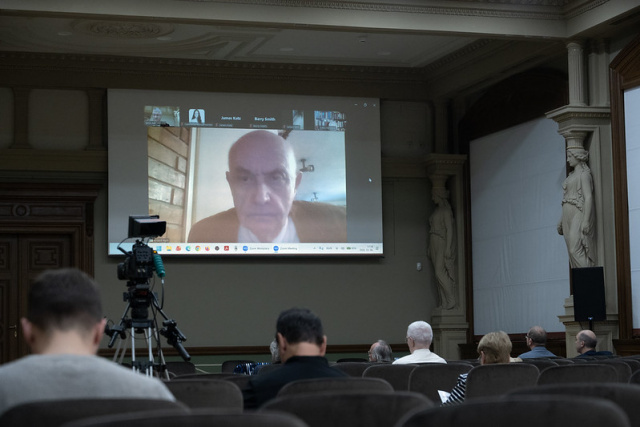 Conference participants listen to Kristóf Nyíri’s introductory remarks Photo: mta.hu / Tamás Szigeti
Among the speakers, Scottish philosopher John Haldane provided an overview of the philosophical foundations of AI. Psychologist and MTA member Valéria Csépe then discussed the dangers of the cognitive offloading made possible by AI. Eörs Szathmáry, an evolutionary biologist and MTA member, examined the anthropological risks posed by self-learning AI. Immunologist and MTA member András Falus explored the use of AI from a medical science perspective.
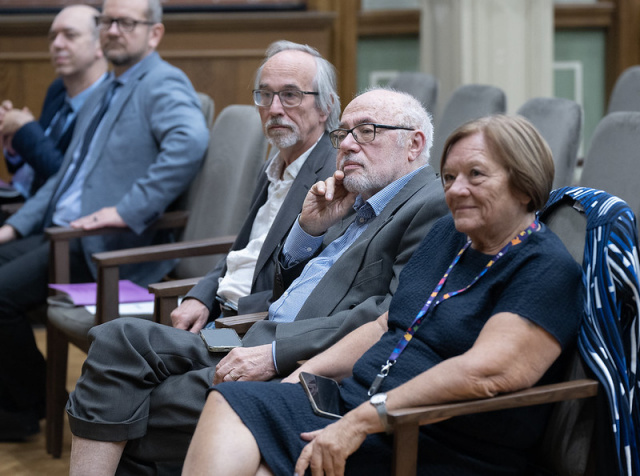 Eörs Szathmáry, András Falus and Valéria Csépe Click on the photograph to view the gallery of images taken at the conference. Photo: mta.hu / Tamás Szigeti
Balázs Szegedy, a mathematician and MTA member, analysed the mathematical relevance of AI, while Zoltán Tanács, Hungary’s Minister for Science and Technology, summarised the political challenges associated with AI.
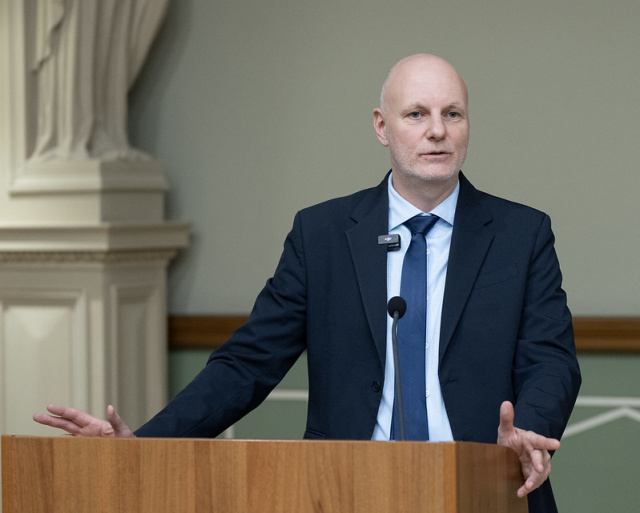 Zoltán Tanács Photo: mta.hu / Tamás Szigeti
The bilingual booklet of abstracts prepared for the conference can be downloaded here.