


Meeting of the Visegrad Group Academies at Smolenice Castle
The annual forum of the academies of sciences of the Visegrad Group (V4) countries was held in Smolenice, Slovakia on 17-18 June 2026, bringing together representatives from the Czech, Hungarian, Polish and Slovak national academies of sciences.
The Hungarian delegation was led by Mihály Pósfai, President of the Hungarian Academy of Sciences, the Slovak delegation by Martin Venhart, President of the Slovak Academy of Sciences, the Czech delegation by Radomír Pánek, President of the Czech Academy of Sciences, and the Polish delegation by Dariusz Jemielniak, Vice President of the Polish Academy of Sciences.
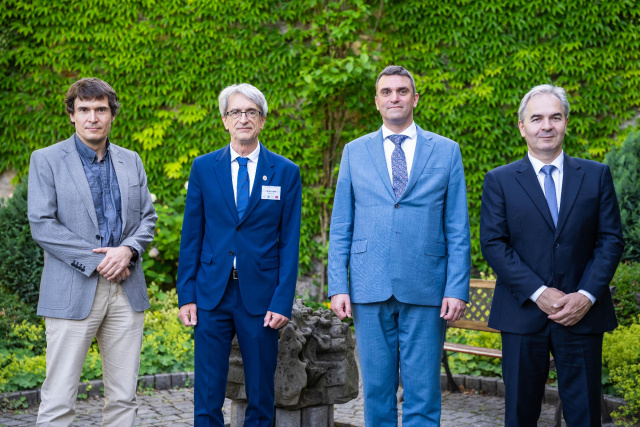 Dariusz Jemielniak, Mihály Pósfai, Martin Venhart and Radomír Pánek Photo credit: Martin Bystriansky/SAV (SAS)
The programme featured three panel discussions. In the first session, Mihály Pósfai presented the priorities of his programme as President of the Hungarian Academy of Sciences (MTA), emphasising stronger research funding and support systems, the safeguarding of scientific integrity and quality assurance in Hungarian science, the importance of science communication, the protection of cultural heritage, the role of scientific support in science and sectoral policymaking, and the development of international relations. In addition, he outlined MTA’s current situation, key recent developments affecting the Academy and Hungarian scientific life, as well as issues that have arisen from ongoing consultations with the government and the research network.
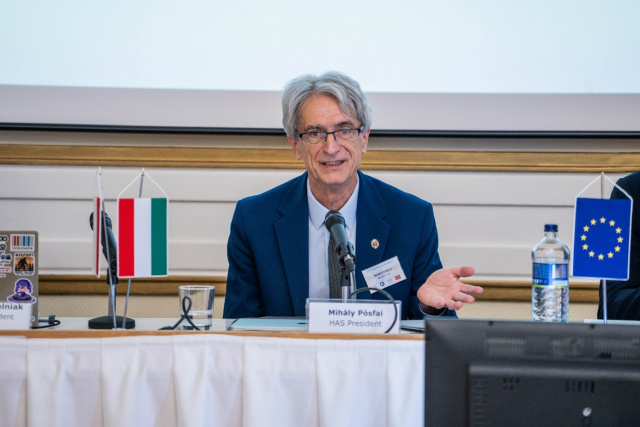 Mihály Pósfai Photo credit: Martin Bystriansky/SAV (SAS)
As part of the Forum, Júlia Koltai, a sociologist, Head of the Lendület (Momentum) Digital Social Science Research Group, Research Professor at the ELTE Centre for Social Sciences, habilitated Associate Professor at the ELTE Faculty of Social Sciences, and member of the Hungarian Young Academy (FKA), gave a presentation. She presented a joint survey conducted by MTA and FKA, which focused on workplace conditions, job satisfaction, career opportunities, and the challenges faced by researchers in Hungary and those with ties to Hungary. Her presentation on research careers and researchers’ future expectations was delivered in a session addressing the opportunities offered by the European Union’s post-2028 research and innovation programmes, chaired by Mr Pósfai. In this context, the Slovak Academy of Sciences proposed expanding the MTA–FKA survey to include the V4 academies, enabling regional comparisons of research careers and working conditions.
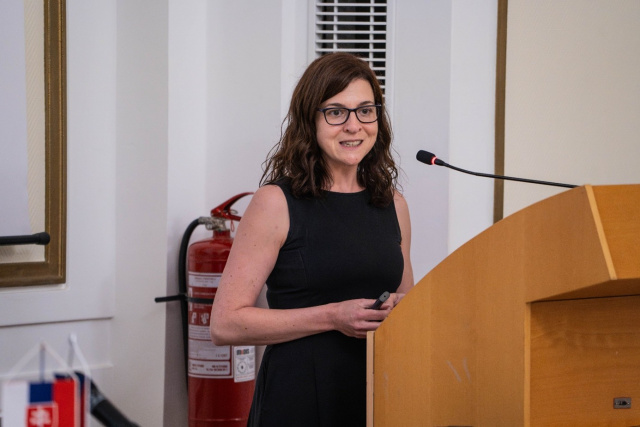 Júlia Koltai Photo credit: Martin Bystriansky/SAV (SAS)
In the third session on 18 June, research security was the main topic. During this session, representatives from the national academies shared their experiences and views on the relationship between openness in scientific collaboration, research integrity, and research security. The participants agreed that national academies play an important role in research security by sharing best practices, supporting each other, and exchanging experiences, as the challenges in this area affect the scientific communities of all countries.
During the meeting, the 2026 edition of the Young Researcher Award of the Visegrád Group Academies was presented. This year’s theme was “Artificial Intelligence in Physical and Engineering Sciences”. The Hungarian award was presented to Alex Kummer, an associate professor at the University of Pannonia. In his presentation, he outlined his main research findings to date, as well as his ongoing research activities, which focus on developing data-driven and artificial intelligence-based methods for solving complex problems in process and systems engineering. At the award ceremony, Mihály Pósfai, MTA President, delivered a laudatory speech for the Hungarian award winner and presented him with a certificate.
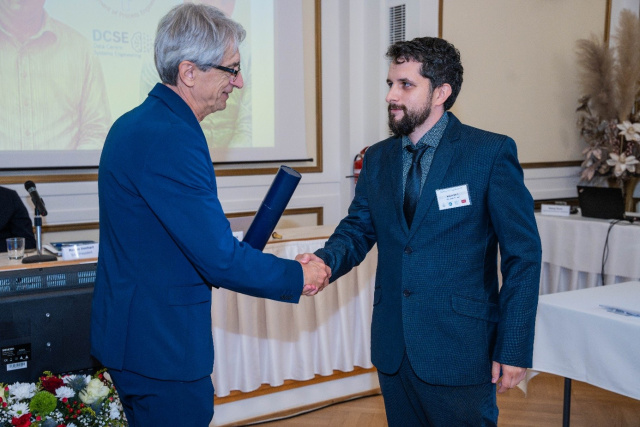 MIhály Pósfai and Alex Kummer Photo credit: Martin Bystriansky/SAV (SAS)
 This year’s recipient of the Czech Academy of Sciences (CAS) award is Michal Jambor, Head of the High Cycle Fatigue Group at the CAS Institute of Physics of Materials, whose research focuses on electron microscopy, fatigue processes in materials, and the study of light metal alloys. Szymon Nakoneczny, Assistant Professor at the Center for Theoretical Physics of the Polish Academy of Sciences, was named the Polish recipient of the award. His research is in the fields of observational and theoretical cosmology, with a particular focus on the application of machine learning methods and the photometric classification of quasars. The recipient of the award for Slovakia is Jaromír Klarák, a scientific researcher at the Institute of Informatics of the Slovak Academy of Sciences (SAS). His research focuses on analysing how scientific research works (the “science of science”), as well as developing and applying artificial intelligence-based models that integrate various types of data.
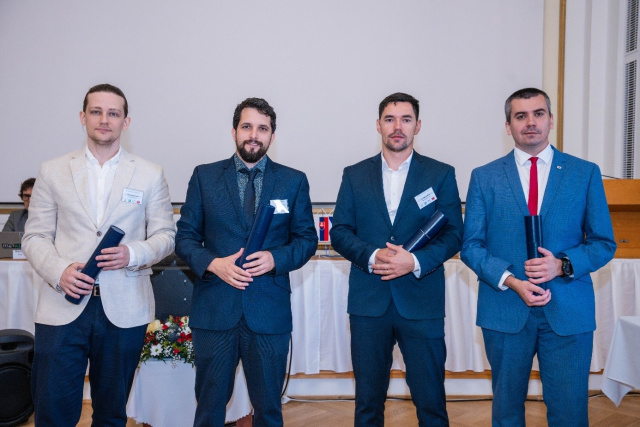 Szymon Nakoneczny, Alex Kummer, Jaromír Klarák, Michal Jambor Fotó: Fotó: Martin Bystriansky/SAV (SAS)
On the sidelines of the event, Zuzana Panczová, Vice President for International Relations at SAS, and Gergely Bőhm, Head of the President’s and Vice Presidents’ Office of MTA, signed the Cooperative Programme for the Agreement on Scientific Cooperation between MTA and SAS (2027–2028). This programme sets out the detailed rules for supporting the mobility of researchers working on joint projects between the two academies.
At the conclusion of the meeting, the presidents of the four academies signed the Statement of the Visegrad Group Academies Forum on the Role of Science in Society and Research Security. The document emphasised that science and scientific institutions play a key role in addressing societal challenges and that it is therefore important to protect reliable, evidence-based knowledge and to combat disinformation and declining trust in science. They highlighted the responsibility of academies to communicate scientific knowledge responsibly and to prevent the misinterpretation and misuse of scientific findings.
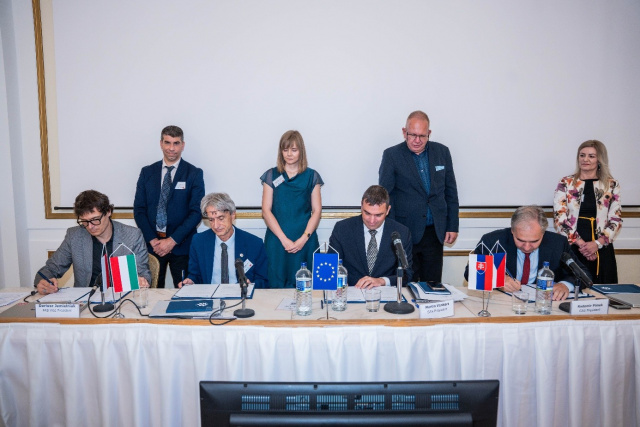
Photo credit: Martin Bystriansky/SAV (SAS)
The presidents drew attention to the fact that new security challenges arising from scientific and technological progress, including issues related to dual-use research, require increased attention. They also emphasised the need to strike a balance between scientific openness and the responsible application of knowledge. Furthermore, they stated that international scientific cooperation must continue to be based on shared ethical standards and the principles of research integrity. In the statement, the Visegrad academies reaffirmed their commitment to scientific excellence, independence and integrity, as well as to strengthening public trust in science.
The next Forum will be hosted by the Hungarian Academy of Sciences in October 2027.