


Scientific cooperation as a form of peacebuilding – UNESCO conference at the Hungarian Academy of Sciences headquarters
Peace is not merely the absence of war, but something we build through law, culture and education, resulting in human dignity, mental well-being and dialogue. This was among the points made by Mihály Pósfai, President of the Hungarian Academy of Sciences (MTA), in his welcome address at the UNESCO conference entitled The Path to Peace, held at the MTA headquarters.
The President of the Academy spoke about how Hungary is currently undergoing a period of profound political change. Such periods bring hope and new opportunities, but they are also accompanied by uncertainty and tensions. Political change alone cannot reconcile a divided society. New institutions and new leaders are not enough. Trust must also be rebuilt – and rebuilding it requires patience and a willingness to listen to one another.
According to President Pósfai, the Hungarian Academy of Sciences is also entering a new era. The most important aim of its leaders is to bring about peace within the Hungarian scientific community. “Not by concealing genuine disagreements, and certainly not by demanding uniformity, but by restoring cooperation among groups that have too often regarded one another with suspicion.”
Hungarian science has been divided by institutional conflicts, political loyalties, disciplinary boundaries, and differences between generations and regions. The Academy should be a common home for researchers working in universities, research institutes and other scholarly communities, regardless of their political views or institutional affiliations.
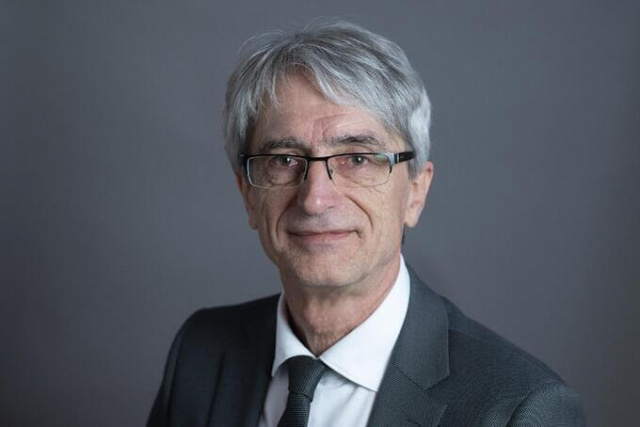 Mihály Pósfai Photo: mta.hu / Tamás Szigeti
Speaking about the importance of science, he noted that science cannot negotiate a ceasefire. But it can clarify facts, expose manipulation, preserve channels of cooperation and help societies make decisions on the basis of knowledge rather than fear. In this sense, scientific cooperation is itself a form of peacebuilding.
The UNESCO conference entitled UNESCO’s Road for Peace programme: Dialogue and Action for Tolerance and Intercultural Understanding, held at the Academy, was attended by Katalin Bogyay, President of the Hungarian National Commission for UNESCO; Zoltán Tarr, Minister of Social Relations and Culture in Hungary; and Khondker M. Talha, President of the General Conference of UNESCO.
In his speech, Minister Tarr emphasised the need to strengthen the mechanisms of dialogue that can help prevent conflicts. As he put it, peace does not require us to be the same; rather, it requires that we learn to cooperate with one another whilst preserving our identities. It is important that dialogue should not be the final step in resolving a crisis, but rather one of the first steps towards preventing conflicts, he said, adding that the path to peace is not simply a political one, but a process that also encompasses education, culture, science and the arts.
Minister Tarr recalled that last year marked the 80th anniversary of the historic commitment enshrined in the Charter of the United Nations to protect post-World War II generations from the horrors of war. The founding principle of the UN remains highly relevant today. “At a time when multilateral cooperation is weakening, it is particularly important to strengthen the factors that can help prevent conflicts,” the minister said.
“Wars originate in people’s minds, so the defences of peace must also be constructed in people’s minds,” the minister quoted from the founding principles of the United Nations Educational, Scientific and Cultural Organization (UNESCO). When UNESCO was established, its founders recognised that peace could not be achieved solely through political and economic means, but also required education, culture, science and communication. “Culture can also be regarded as a form of “soft power”, which can be an important source of rebuilding trust, establishing and maintaining peace, and managing conflicts,” the minister explained.