


One of the leading figures in higher-dimensional algebraic geometry – János Kollár, an external member of the Hungarian Academy of Sciences, receives the János Bolyai International Mathematics Award at a formal ceremony
The prestigious award is presented by the Hungarian Academy of Sciences every five years to the author of an outstanding mathematical monograph published anywhere in the world and in any language during the preceding 15 years, presenting the author’s own original results and methods of groundbreaking significance. The author’s previous scientific achievements are also taken into account. The committee responsible for selecting the recipient awarded the prize to János Kollár for his book Families of Varieties of General Type. According to the committee, Kollár’s results have had an invaluable impact on modern complex algebraic geometry.
“For Hungarian mathematics, this celebration is a continuation of an exceptionally rich tradition. It also serves as a reminder that this tradition lives on through people: in families, schools, teachers and research communities, and then through collaborations that transcend national borders,” said Mihály Pósfai, President of the Hungarian Academy of Sciences (MTA), in his ceremonial address. In his view, for the Academy, the Bolyai Prize represents a contribution to the international scientific community’s collective judgement of achievement. As a Hungarian institution, the Academy recognises work of universal significance. Today, we are especially pleased that the award recipient belongs to both the Hungarian mathematical community and our Academy.”
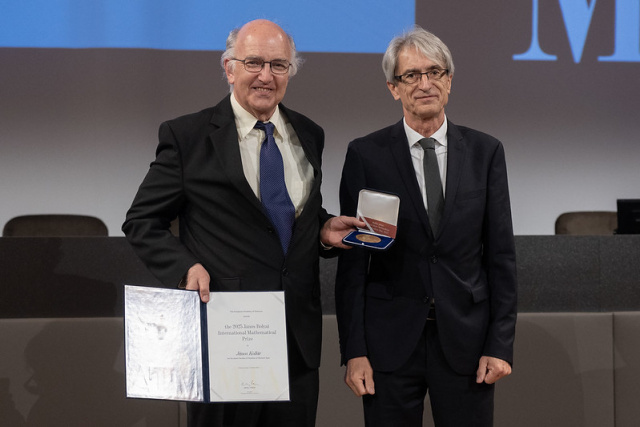 János Kollár and Mihály Pósfai Photo: mta.hu / Tamás Szigeti
“There is something else that gives today’s celebration particular significance: we are honouring a mathematician of flesh and blood. Almost every day, we read news reports about mathematical problems solved by artificial intelligence. We are living in extraordinary times, and mathematics is also going through an extraordinary period. We do not know how the human role in discovery will change, and in a few years, we may be talking about who solved a problem in an entirely different way. That is precisely why we should cherish this moment. The person whose work we are celebrating is here among us. His life is connected to family memories, teachers, colleagues and friendships, and we can express our appreciation to him in person.”
Zsolt Páles, an academician and President of MTA’s Section of Mathematics, described Kollár as one of the most influential figures in contemporary mathematics, particularly in higher-dimensional algebraic geometry. Páles explained: “According to the prize committee, which consists of five full members of the Academy’s Section of Mathematical Sciences and five distinguished foreign mathematicians, although classification problems arise in almost every area of mathematics, algebraic geometry has a distinctive approach: it does not regard a classification problem as complete simply because the objects in question have been classified by the elements of a set. Rather, it seeks to equip these classification sets with a geometric structure. This idea leads to what is known as moduli theory. In this framework, objects are classified by constructing moduli spaces, allowing us to parametrise them.
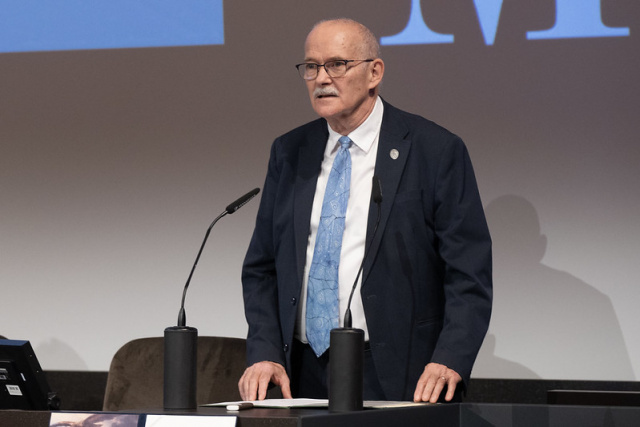 Zsolt Páles Photo: mta.hu / Tamás Szigeti
“A classic example of this is the construction of the moduli space of smooth curves of genus at least two. This was the culmination of a century-long programme that began with Riemann and culminated in the work of Deligne, Grothendieck and Mumford. Mumford introduced geometric invariant theory (GIT), which uses the quotient of a variety by a suitable reductive algebraic group. The end result is the moduli space of stable curves, which provides a geometric compactification of the moduli space of smooth curves. Gieseker took the first step towards solving the analogous problem in higher dimensions in 1977.
“However, no one had succeeded in applying GIT methods beyond the case of curves. The 1988 paper Threefolds and Deformations of Surface Singularities, by Kollár and N. Shepherd-Barron, marked a breakthrough in the theory of higher-dimensional moduli spaces. This paper proposed the use of methods from birational geometry instead of GIT. It launched a monumental programme that encompassed more than 30 major papers by Kollár and culminated in his book Families of Varieties of General Type.”
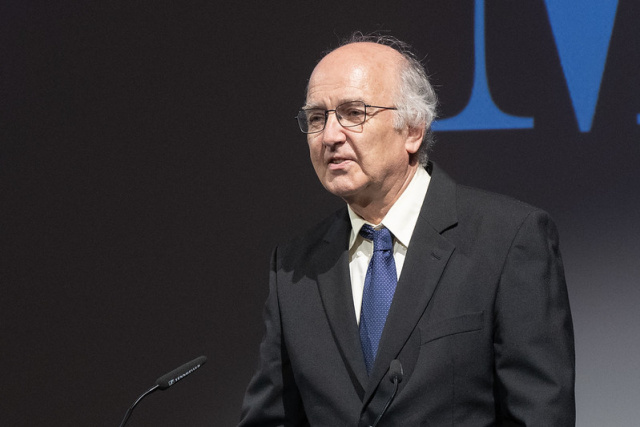 János Kollár Photo: mta.hu / Tamás Szigeti
As part of the ceremony, Sándor Kovács, Professor at the University of Washington, gave a lecture on Kollár’s distinctive body of work and its influence on the development of algebraic geometry. Kollár, an external member of MTA and a professor at Princeton University, then gave a lecture entitled ‘Which Surfaces Can Be Constructed from Circles?’
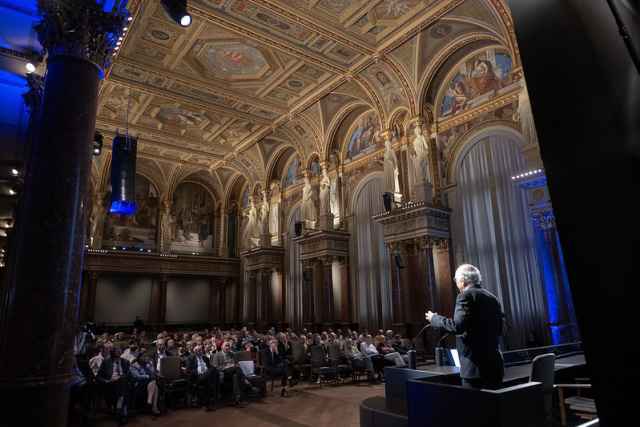 Click on the photo for more images Photo: mta.hu / Tamás Szigeti
The János Bolyai International Mathematical Award
The Academy established the award in 1902 to mark the centenary of the birth of the world-renowned Hungarian mathematician János Bolyai and to recognise outstanding mathematical works. The awarding of the medal was interrupted by the outbreak of the First World War. In 1994, the Hungarian Academy of Sciences (MTA) re-established the award as the János Bolyai International Mathematics Award.
The prestigious prize is awarded by MTA every five years to the author of the finest mathematical monograph published anywhere in the world and in any language during the preceding fifteen years, presenting the author’s own original results and methods of groundbreaking significance. The author’s previous scientific achievements are also taken into account.
One year before the presenting of the award, the Academy’s Section of Mathematics appoints a committee comprising five full members and five distinguished foreign mathematicians, and appoints its chair.
The Hungarian members of the János Bolyai International Mathematics Award Committee are Miklós Laczkovich (Chair), László Babai (University of Chicago), Imre Bárány (HUN–REN Alfréd Rényi Institute of Mathematics), András Stipsicz (HUN–REN Alfréd Rényi Institute of Mathematics), and Bálint Tóth (HUN–REN Alfréd Rényi Institute of Mathematics).
The foreign members are Alexander Lubotzky (Hebrew University), László Erdős (Institute of Science and Technology Austria), Martin Hairer (École Polytechnique Fédérale de Lausanne), Richard Thomas (Imperial College London), and Éva Tardos (Cornell University Computer and Information Sciences).
The prize consists of USD 25,000 and a gilded bronze medal produced using the original designs.