


Hungarian researcher wins a European Research Council Synergy Grant
With the support of the European Research Council (ERC), Beatrix F. Romhányi, Doctor of the Hungarian Academy of Sciences and Senior Research Fellow at the Institute of Archaeology, ELTE Research Centre for the Humanities, will investigate the historical development of Central and Eastern Europe between the 14th and 18th centuries, in collaboration with Czech and Polish researchers. The six-year international research project has received €10 million in funding and aims to answer the question of how a region once firmly integrated into Europe’s commercial, political, religious and cultural networks became part of Europe’s semi-periphery by the end of the 18th century.
The European Research Council (ERC) operates the European Union’s largest grant programme for frontier research. Its mission is to provide attractive long-term funding to support pioneering, high-risk research with the potential for high returns.
Among the ERC’s funding schemes, Synergy Grants support ambitious, groundbreaking research projects carried out jointly by two to four principal investigators. The participating researchers may come from different disciplines, combining their complementary expertise, methods and resources. Each project can generally receive €10.4 million in funding for a period of up to six years.
The six-year international research project, entitled EDGE – The Experience of Diversity as the Genesis of East-Central Europe (14th - 18th centuries) –, is led by Beatrix F. Romhányi, whose research focuses on the historical geography, settlement networks and ecclesiastical history of medieval Hungary. Her two fellow principal investigators are Polish researcher Bogumił Szady of the John Paul II Catholic University of Lublin, who specialises in historical geography and digital humanities, and Petr Elbel from the Czech Republic, who researches ecclesiastical institutions at Masaryk University in Brno.
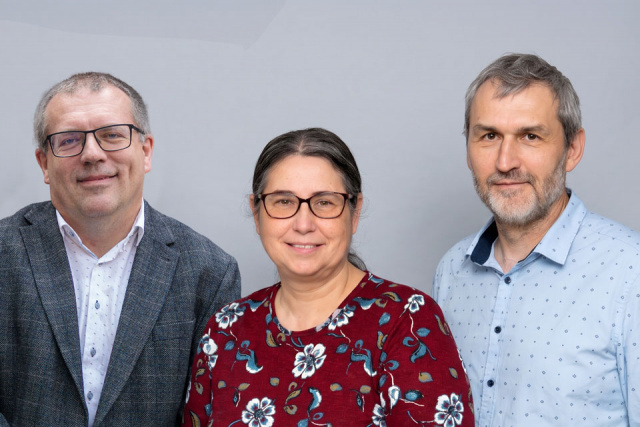 Petr Elbel, F. Romhányi Beatrix and Bogumił Szady
Photo: (c) Masarykova univerzita, ri.abtk.hu, csm.kul.pl / Bogumił Szady - Tomasz Koryszko / KUL
With ERC support, the programme will be carried out in Hungary at the ELTE Research Centre for the Humanities, Institute of History. The three researchers aim to offer a new interpretation of the historical development of East-Central Europe between the 14th and 18th centuries.
Traditional historical explanations have attributed Eastern and Central Europe’s lag in development primarily to delayed modernisation, a weaker network of towns, political fragmentation and divergence from Western development models.
The leaders of the EDGE project take a different approach, arguing that the region’s institutional, ethnic, linguistic and religious diversity was not necessarily a sign of weakness, but rather, over a long period, was one of the most important sources of adaptability, social resilience and institutional innovation.
EDGE’s most significant methodological innovation is that it takes the parish, together with similar local institutions found in other denominations, as the basic unit of historical comparison.
From the Middle Ages onwards, the parish provided a relatively stable framework for local organisation, performing not only religious but also social, economic and administrative functions. Through parish networks, it is therefore possible to compare various phenomena, including population distribution, education, taxation, trade, settlement hierarchies and the density of local institutions.
The research aims to analyse data relating to approximately 30,000 parishes and comparable local institutional units. Its main geographical focus will be the historical Kingdom of Hungary, the Czech lands and Poland–Lithuania. This will also include neighbouring regions.
The researchers will develop an international, multilingual historical data model as part of the project. Geographic information systems and statistical methods will be used to examine regional differences. Institutional hierarchies, specifically the roles played by cities, market towns, villages, ecclesiastical centres and other institutions, will be reconstructed. This will also help them determine the extent to which regional differences in the modern and contemporary periods can be traced back to institutional developments in the Middle Ages and the early modern period.
The project will examine two central hypotheses. First, that the process of becoming peripheral unfolded differently across regions and periods. Second, that Ottoman expansion, Habsburg centralisation, and the partitions of Poland fundamentally transformed local institutional systems.
A key feature of the methodology is the close integration of quantitative analysis with traditional historical source criticism. The researchers will verify statistical findings through local case studies and philological analysis, thereby avoiding the reduction of historical phenomena to mere numerical data.
A total of 957 proposals were submitted for this call, of which approximately one in twenty were selected for funding.
The successful teams will receive an average of €10.4 million per project.
The selected projects will be carried out at universities and research centres in
26 countries across Europe and beyond. Germany (22 projects), the United Kingdom (23), France (14) and the United States (12) will host the highest numbers of successful teams.
Six projects will take place in countries that have so far hosted relatively few ERC grants - Poland (3), Czech Republic (2), Greece (1), Portugal (1), Hungary (1) and Romania (1).
The international reach of the Synergy Grants is also reflected in the fact that around 35% of the funded projects will involve researchers based outside the EU and associated countries, most of them in the United States. Finally, women account for approximately 25% of the researchers participating in the selected projects.
The list of the 48 research teams awarded ERC Synergy Grants in 2026 can be viewed here.