


EASAC: Restoring Europe’s natural habitats would deliver a tenfold return on investment
The European Academies Science Advisory Council (EASAC) has presented its official scientific opinion on the European Union’s Nature Restoration Regulation. According to EASAC’s professional commentary, restoring nature and halting biodiversity loss are among the most important tools for mitigating the harmful effects of climate change, which can be measured in hundreds of billions of euros. The implementation of EU directives at the national level represents a strategic investment that will pay off handsomely in terms of the security, well-being, health, ecological stability and economic resilience of Member States. For this reason, the full implementation of the EU Nature Restoration Regulation is not merely a legal obligation.
On 15 January 2026, EASAC presented its position paper entitled Opportunities in Nature Restoration on the EU’s Nature Restoration Regulation, which encourages Member States to implement the related directive.
As is well known, the EU Nature Restoration Regulation – Regulation (EU) 2024/1991 – entered into force on 18 August 2024 as part of the European Green Deal and the EU Biodiversity Strategy for the period up to 2030. The aim of the legislation is to restore ecosystems, habitats and species in the EU’s terrestrial and marine areas in order to halt biodiversity loss and achieve the EU’s climate change adaptation objectives by mitigating climate change. Restoration measures must cover at least 20% of land and marine areas at the EU level by 2030, and by 2050 they must extend to all ecosystems in need of restoration. Measures must be implemented across terrestrial, coastal, freshwater, forest, agricultural and urban ecosystems covered by the Regulation. In addition, at least 25,000 kilometres of river stretches must be restored to their natural state, and the decline in pollinator populations must be halted. Member States (including Hungary) must submit their draft national recovery plans to the European Commission by August 2026.
 Photo: Nagy Attila Károly / HAS
The EASAC position paper presented on Thursday was prepared under the leadership of Thomas Elmqvist, EASAC’s Environmental Programme Director, and coordinated by the EASAC Environment Steering Panel. The recommendation is based in part on the analyses and recommendations of previously published EASAC studies, but places them in a new and different policy context, thereby communicating the earlier work in a more targeted and timely manner. The press conference setting forth EASAC’s commentary was held by Prof Elmqvist, András Báldi, and Fiona Regan, Co-Chairs of EASAC’s Environment Steering Panel.
150 billion euros in investment, 1.8 trillion euros in benefits
According to EASAC’s position paper, Europe is facing a steep rise in the costs of climate-related damage, at a time when pressure on the use of public funds is increasing and debates on competitiveness and security have intensified.
The document concludes that the short-term cost of restoring Europe’s degraded ecosystems, estimated at around €150 billion, is outweighed at least tenfold by the benefits of avoiding climate-related losses, improving public health, enhancing resilience and adaptation to climate change, and ensuring more reliable and secure food and water supplies. Taken together, these benefits could amount to at least €1.8 trillion over the coming decades.
“Restoring nature is not an environmental luxury, but essential risk management,” said Prof Elmqvist, serving as lead author of the study. “At a time when Europe is forced to spend billions responding to floods, droughts, forest fires and health impacts, restoring ecosystems is one of the smartest preventive investments we can make.”
Environmental destruction poses an increasing threat to Europe’s security
Europe’s natural systems are already extremely severely damaged. According to EASAC data, only 1.4% of Europe’s forests can be considered intact, and only 3.3% of land areas can be said to have minimal human intervention. These environmental losses are directly linked to increasing flood damage, declining soil fertility, the weakened carbon sequestration capacity of forests, and the growing risk of more frequent forest fires.
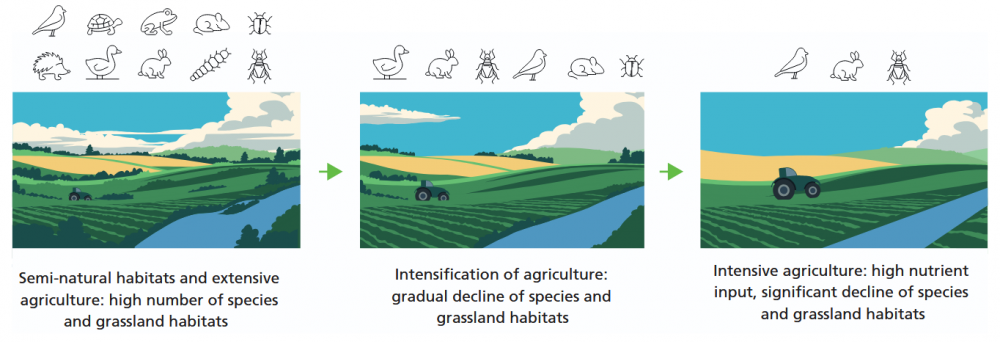 Decline in farmland biodiversity owing to intensification of land use. Source: Sustainable use of plant protection products Graphic: EASAC
The era of outdated economic models that treat nature as expendable is finally over. Our economy must be based on healthy ecosystems, as science has now proven beyond doubt. Healthy natural systems protect infrastructure, stabilise food supplies, and reduce public spending on disaster relief and healthcare. “Ignoring the economic role of nature is a serious economic and strategic mistake,” Prof Elmqvist emphasised. “Neoclassical economics continues to underestimate the role of nature and biodiversity in economic development. However, when ecosystems collapse, the costs are borne by citizens, insurers and governments.”
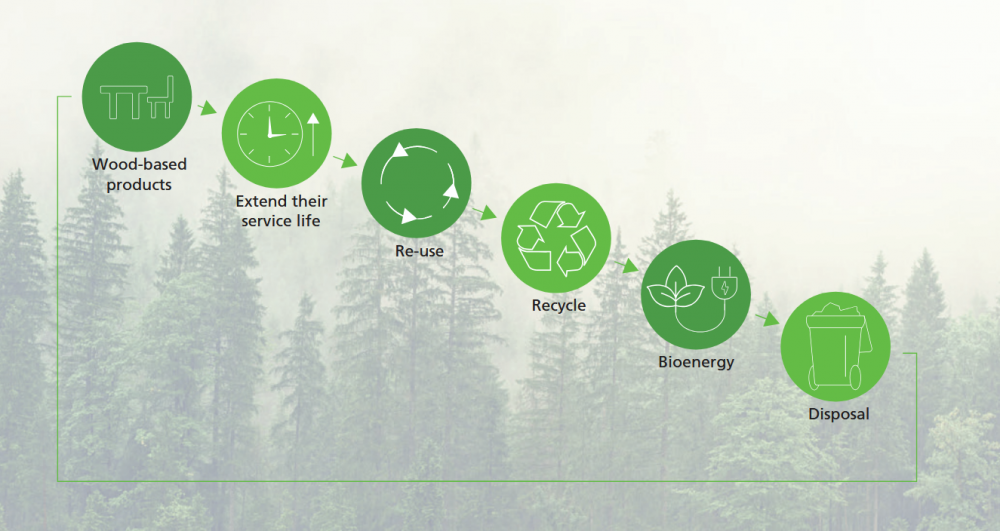 EU Cascade priorities for forest biomass Graphic: EASAC
The EASAC position paper calls for immediate, high-impact restoration measures in the following three key ecosystems.
Agricultural landscapes: A transition to regenerative agriculture is needed, which can restore soil organic matter, biodiversity, water retention capacity, and climate change resilience, while sustaining yields. The primary tools for this transition are diversified crop rotations and intercropping, cover crops and perennial crops, reduced tillage, agroforestry, increasing the number of landscape features, and integrated pest management. Policies should encourage and reward measurable outcomes, including increased carbon storage in soils, improved biodiversity, and improved water regulation.
Forests: The capacity of forests to absorb atmospheric carbon dioxide is steadily declining due to climate stress and increased logging. Close-to-nature forest management, mixed-species and mixed-age stands, habitat protection, and the management of fire-prone biomass in line with landscape characteristics can reduce the risk of forest fires and restore forest resilience. Bioenergy incentive schemes should prioritise the use of biomass residues. Carbon stocks stored in forests must be restored.
Peatlands: Rewetting previously drained peatlands can significantly reduce greenhouse gas emissions, mitigate the risk of wildfires, improve water retention and restore biodiversity.
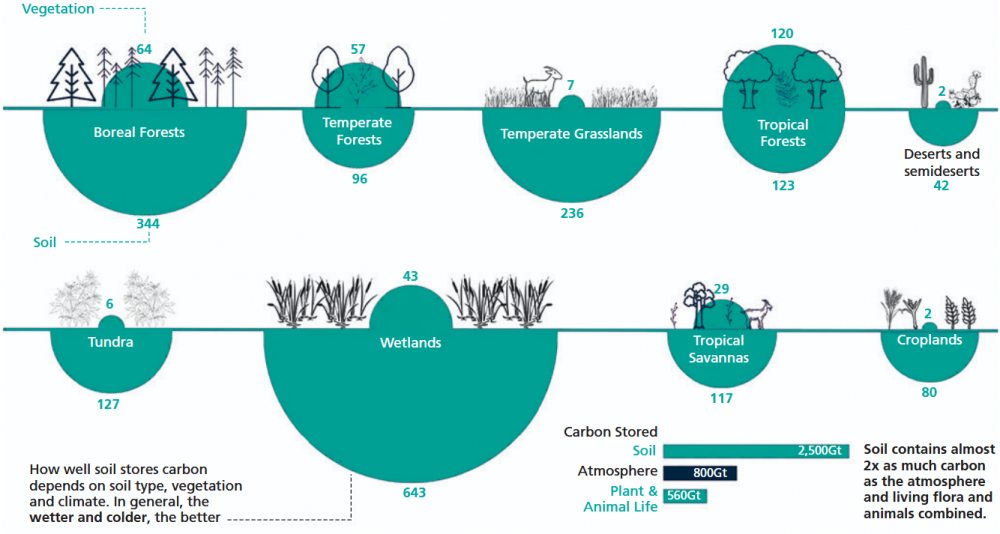 Distribution of carbon below and above ground in different types of ecosystem (in tonnes per hectare) Source: IPCC, NASA, visualcapitalist.com, Miranda Smith.
The 3+1 main points of the EASAC commentary:
- Nature must be treated and financed as a strategic asset. Europe’s natural assets – soil, biomass, peatlands, wetlands, rivers and marine ecosystems – are essential for carbon storage, water regulation, biodiversity, and food and energy security. These natural assets must be recognised and acknowledged, their inestimable value must be understood, they must be treated as a strategic priority, their condition must be continuously monitored, and their preservation must be financed.
- Coherent policies and governance across sectors are needed. The rehabilitation and restoration of natural habitats cannot be achieved in isolation. It requires cooperation among agriculture, forestry, water management, energy, and marine and urban systems, with clear institutional support and accountability.
- General preventive restoration. This is the most effective and efficient way to reduce disaster risks, protect our natural assets and economy from climate extremes, and enhance Europe’s resilience and strategic autonomy.
- EASAC warns about political backsliding. According to EASAC, delaying or implementing the Nature Restoration Regulation superficially would increase Europe’s exposure to climate extremes, economic losses and health impacts.
“As scientists, we are alarmed by the accelerating reversal of critical environmental and climate protections. Environmental rollbacks do not eliminate costs, rather, they merely shift them forward. It is vital that Member States concentrate on fulfilling the Regulation’s objectives instead of seeking to weaken its provisions,” said Prof Fiona Regan, Co-Chair of the EASAC Environment Steering Panel.
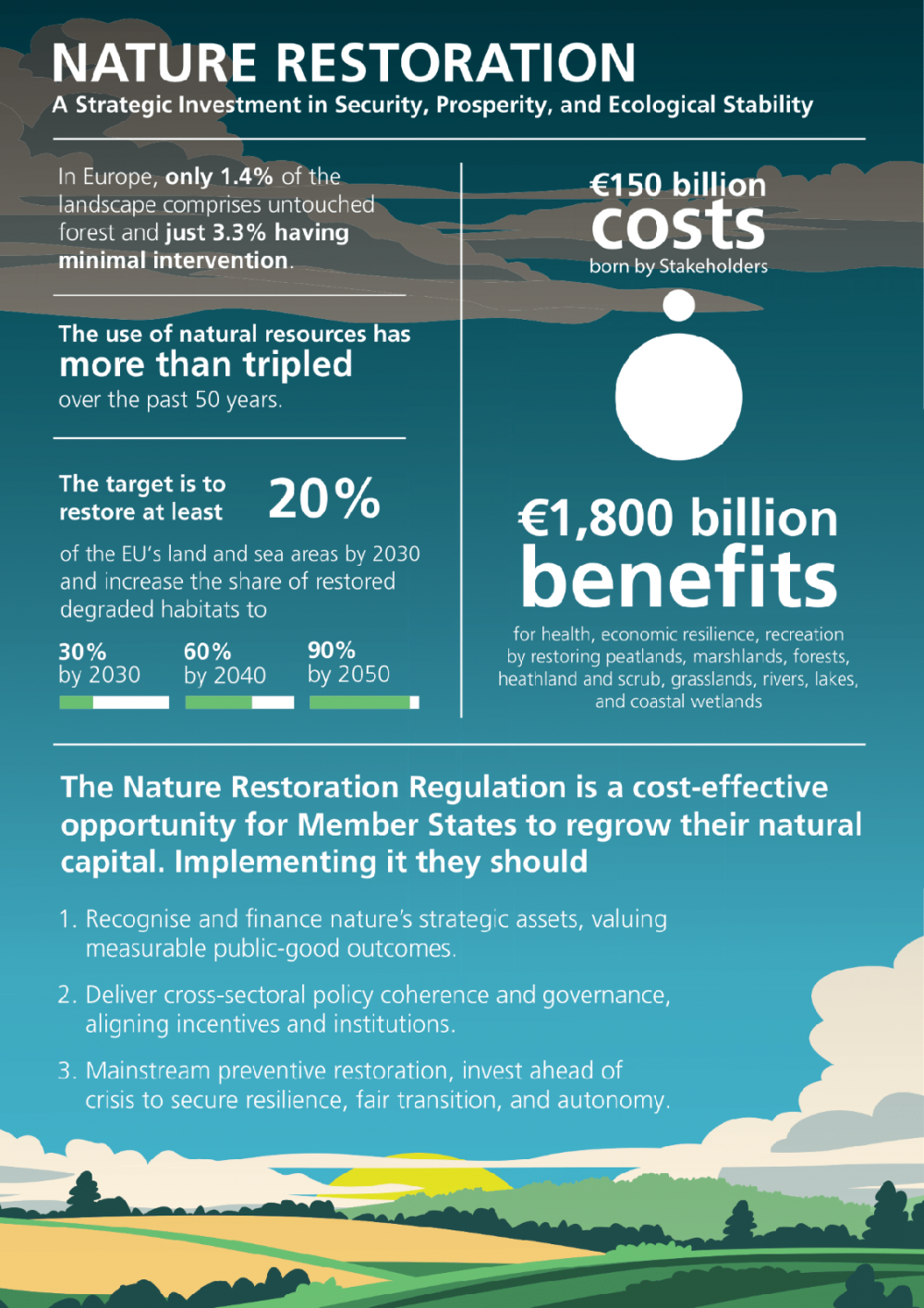 Infographic: EASAC
At the press conference, ecologist András Báldi, corresponding member of the Hungarian Academy of Sciences, emphasised that the new document from EASAC, which brings together the academies of 28 European countries, including the Hungarian Academy of Sciences, is not the dissenting opinion of a few researchers, but an important position statement based on the consensus of European academies, summarising the previous findings of a Europe-wide scientific network.
Prof Elmqvist noted in this regard that most EU member states have not yet prepared their own action plans, even as time is running out. The recently published EASAC commentary will be sent to all EU governments so that its content can be discussed at the highest ministerial levels. According to Prof Báldi, “In Hungary, consultations are under way, coordinated by the Ministry of Agriculture, to address the many outstanding issues relevant to our country, with the HUN–REN Centre for Ecological Research participating on the scientific community side. I am very confident that this shared commitment to action will ultimately bear fruit and that we will make significant progress in preserving and restoring our country’s natural assets.”
EASAC was established in 2001 by the national academies of science of the EU Member States on the initiative of the Royal Swedish Academy of Sciences, with the aim of jointly formulating recommendations for policymakers. Through EASAC, Europe’s scientific academies can act in a coordinated manner and make their voices heard collectively on policy issues. The Hungarian Academy of Sciences is also a member of the organisation, representing Hungarian research interests in this important European scientific body.