


1860: The Academy’s headquarters design competition is held with the help of a substantial donation from Baron Simon Sina
On 5 May 2025, as the opening event of the 199th Ceremonial General Assembly of the Hungarian Academy of Sciences, the public artwork titled The Boundless History was unveiled. The installation was commissioned by the Hungarian Academy of Sciences and the Municipality of Budapest to mark the 200th anniversary of the Academy’s founding. In this series, we highlight key events featured on the timeline composed of 200 slabs of Tardos limestone.
For decades after its founding, the Hungarian Academy of Sciences did not have its own headquarters. Its offices were housed in rented buildings in Pest, while its meetings were held in the ceremonial hall of the Pest County Hall. In 1858, Baron Simon Sina (1810–1876) made a substantial donation of 80,000 forints toward the construction of the Hungarian Academy of Sciences’ headquarters. Just as Count István Széchenyi’s contribution towards the establishment of the Learned Society was a faithful reflection of the role played in the political and cultural nation-building programme by one of the key social groups of the time, the increasingly Magyarised landed nobility, Sina is a good example of the philanthropic activities of the bourgeoisie enriched through industrial and commercial enterprise. The Sina family originated from the region bordering the northwestern border of present-day Greece, in what is now Albania, and its members were merchants, Greek Orthodox, Greek-speaking subjects of the Ottoman Empire. In the mid-18th century, they settled in the Habsburg Monarchy, where they continued their wholesale trading operations linking the Ottoman Empire and the Habsburg Empire. As their wealth grew, so did their influence: the elder Simon Sina was granted the title of baron in 1818, while his son and grandson undertook diplomatic assignments in Austrian–Greek relations in the mid-19th century. Their patronage extended to the Kingdom of Greece, the Kingdom of Hungary and the Habsburg Monarchy.
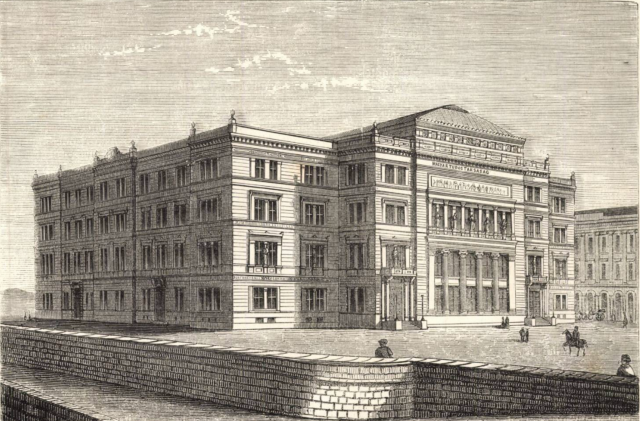
The donation intended for the construction of the headquarters sparked a nationwide movement, and within barely two years, enough money had been raised to begin preparations for the design and construction. Three architects participated in the invitation-only design competition, as a fourth entrant, Miklós Ybl, withdrew his design the day after submitting it. The Gothic-style designs of Imre Henszlmann and his associates, as well as those of Antal Ferstel, were not well-received by the architectural community or the public due to them being perceived as overly Germanic and ecclesiastical in character, with an anticipated cost of 1.5 to 3 million forints, which was enormous. Antal Szkalnitzky’s Classical design also failed to win the judges’ approval. The dilemma of choosing a style for the representative headquarters for Hungarian science was not merely an aesthetic issue, but also a political one: the public viewed the search for a national style as an integral part of a fully developed national identity. Dissatisfied with the submissions, the Academy’s Building Committee invited two experienced masters to participate in the competition: of the Classical designs submitted by the Bavarian royal architect Leo von Klenze and Friedrich August Stüler, a professor at the Berlin Academy, the latter’s design was selected as the winner. Based on Stüler’s design, the palace was built between 1862 and 1865 through public donations, marking the beginning of Neo-Renaissance Historicism in Hungary. The construction work was carried out by Hungarian craftsmen, while the sculptural and artistic tasks were largely carried out by Prussian masters. This division of labour highlighted the increasingly pressing need to establish a Hungarian system of artistic training. The construction of the headquarters ultimately exceeded the original budget by one-third, with the total cost reaching 800,000 forints. The square formerly known as Kirakodó tér, which had served commercial purposes, became one of Pest’s most representative public spaces thanks to the Academy building and the Lloyd’s headquarters.