


Boundless History:1833 – Count István Széchenyi’s work Stadium, a summary of his reform plans, is published and dedicated to the nation’s legislators
On 5 May 2025, as the opening event of the 199th Ceremonial General Assembly of the Hungarian Academy of Sciences, the public artwork titled The Boundless History was unveiled. The installation was commissioned by the Hungarian Academy of Sciences and the Municipality of Budapest to mark the 200th anniversary of the Academy’s founding. In this series, we highlight key events featured on the timeline composed of 200 slabs of Tardos limestone.
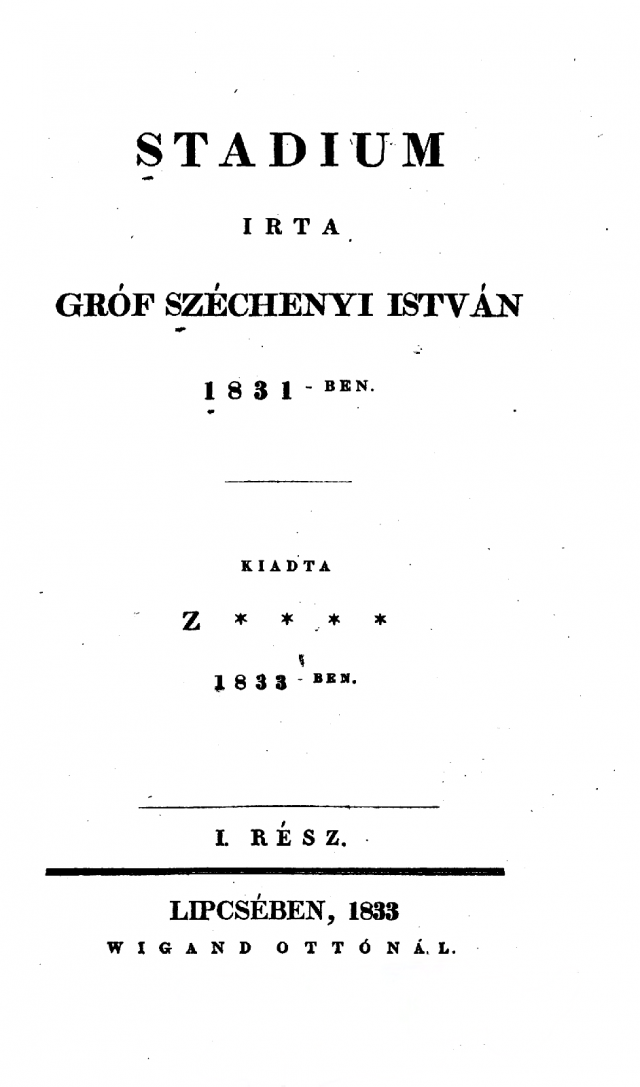
Széchenyi’s Stadium had a long and eventful journey before the author himself was finally able to hold a copy of the printed volume in his hands in November 1833.
Széchenyi originally intended Stadium (Stage) as a continuation of his 1830 work Hitel (Credit), and gave his manuscript the working title Bírói Zálog (Judicial Mortgage). Work on this project, however, came to a halt following the publication of József Dessewffy’s critique titled A Hitel czímű munka taglalatja (An Analysis of the Work Entitled Hitel) in 1831. In response, Széchenyi set aside Bírói Zálog and wrote Világ (World) instead.
Only notes from the Bírói Zálog manuscript have survived, which Széchenyi used while writing Stadium. He continued working on it from November 1831, although the manuscript was still not known by its final title; at that time it bore the title Reformatio (Regeneratio), a designation that more clearly reflected its content. The work’s final title, Stadium, referred both to the existing state of affairs and to the next phase of reforms, for which he drafted twelve legislative proposals.
The manuscript was completed in April 1832, and printing began in May. Eleven sheets had already been printed when the Lieutenancy Council ordered the work to be halted and prohibited further work on it. Széchenyi subsequently took charge of publishing his work himself and, having added a publisher’s preface, sent the manuscript to Otto Wigand’s publishing house in Leipzig. Printed copies arrived in Pressburg (Bratislava) in November 1833.
In Stadium, Széchenyi first addresses the representatives of Hungary, by which he meant the members of the Hungarian Diet (National Assembly): “To preserve a nation for humanity ‒ this, and nothing less, is at stake now, and it depends on us to bring this about successfully.” With these words he defined the objective of his new work. Following the two prefaces, under the heading Act XII, he lists the social and economic issues that he believed required reform if this goal was to be attained. These included issues concerning credit and landed property, equality before the law, and the use of Hungarian in legal proceedings. According to his proposals, the Lieutenancy Council was to be responsible for the implementation of the laws, while Széchenyi also demanded greater transparency in the administration of justice. After briefly reviewing the most pressing economic and social issues of his age, he discussed each of the first nine laws at length in separate chapters. He outlined the existing problems and explained the benefits the country would gain if reform was enacted. The fact that he placed the issue of credit at the forefront demonstrates not only the connection with Hitel and the significance of the working title Bírói Zálog, but also the importance he attached to the problem itself.
Széchenyi planned to address the last three laws, which he had not yet elaborated on, at a later date. He began elaborating the tenth law, concerning the Hungarian language, in September 1834, and completed the work by mid-December. This manuscript eventually received the title Hunnia, although it was not published until much later, in 1860. “Hitel, Világ, and Stádium! You three / Not merely a handwritten book that philosophises and teaches, / But on the border between being and non-being / A triple pyramid reaching to the heavens!” ‒ wrote János Arany in his elegy titled In Memory of Széchenyi (1860).