

News
Record number of visitors at the XXV. Nobel Laureate Meeting
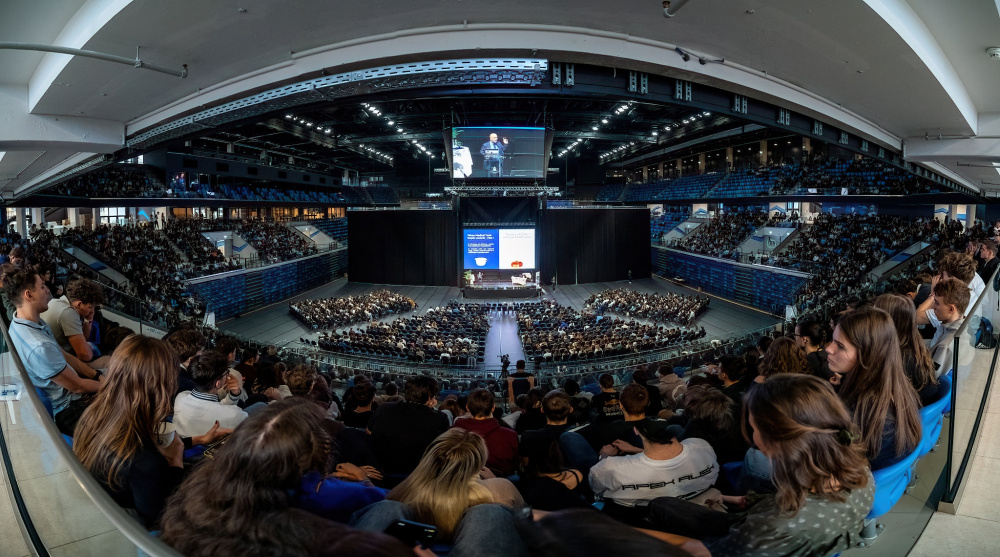
The XXV. Meeting of Nobel Laureates and Talented Students, jointly organized by the National Academy of Scientist Education operating in Hungary and the Academia Europaea Budapest Hub, held in November at Szeged’s largest capacity venue, attracted more visitors than ever before – approximately four thousand guests. Thousands of secondary school pupils, along with hundreds of teachers, university students and mentors, awaited the arrival of Nobel Laureate Professor Sir Peter Ratcliffe. The event also saw the announcement that the National Academy of Scientist Education is expanding into a new scientific field: chemistry.
The twenty-fifth Meeting of Nobel Laureates and Talented Students was held in Szeged at the end of November with a record number of participants. The event was attended by 3,400 Szent-Györgyi Pupils, 150 Szent-Györgyi Teachers, more than 200 Szent-Györgyi University Students and 200 Szent-Györgyi Mentors who listened to Nobel Laureate Peter Ratcliffe’s lecture. The British scientist, who is a researcher at the Oxford Ludwig Institute for Cancer Research and a Fellow of the Royal Society, received the highest-level medical-physiological award in 2019 for discovering how cells sense oxygen availability and adapt to changes in it, with particular focus on oxygen deficiency, or hypoxia. The conference’s another guest of honour was Shahrokh Shariat, an Iranian-born physician who serves as the head of the Department of Urology at the Medical University of Vienna and is one of the most highly regarded experts in urological oncology. The researcher was present at the NASE’s event last December as well, where the audience followed his presentation with particular attention. At this year’s conference, Péter Hegyi NASE Programme Director and Professor at both Semmelweis University and the University of Pécs, as well as Director of the Academia Europaea Budapest Knowledge Hub, participated as the third guest of honour. His special lecture was prompted by the fact that this September he received the Robert F. Pitts Award from the International Union of Physiological Sciences (IUPS) for his outstanding research work – one of the greatest honours in the global physiological science community.
_fit_1000x10000.JPG?key=b81a780898c6bf6518e2a21ce669002b)
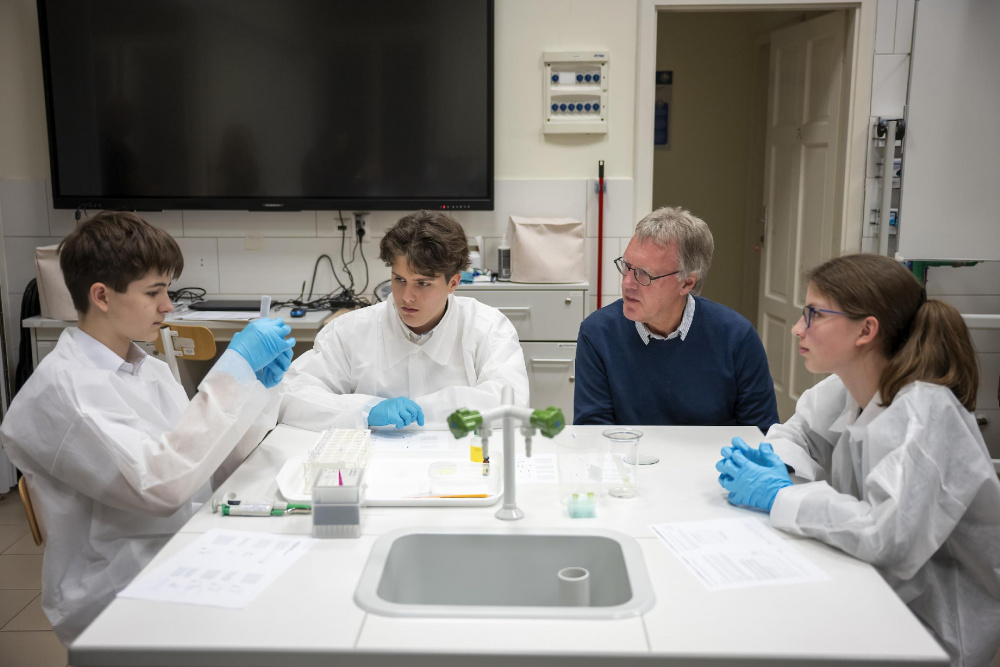
On the first day of the conference, the Nobel Laureate guest of honour visited the Radnóti Miklós Experimental Grammar School in Szeged to observe a practical lesson in the Termosz laboratory. At the laboratory benches, more than 15 ninth and eleventh grade students awaited the researcher with well-prepared experiments. The younger secondary school pupils separated vitamin B12 and haemoglobin using size-exclusion chromatography, while the older children examined the genetic background of sickle cell anaemia using gel electrophoresis. In addition, the participants also performed thin-layer chromatography to separate plant pigments. Since the pupils were already well familiar with the background of these techniques, they could confidently answer the researcher’s questions. In the laboratory, the Nobel Laureate scientist’s wife, Fiona Ratcliffe, was also present and had conversations with the children, as did physicist Péter Dombi. The former Student of Nobel Laureate Ferenc Krausz participated in the visit as head of the Ultrafast Nanooptics Research Group at the HUN-REN Wigner Research Centre for Physics. Péter Hegyi, Programme Director, also joined the pupils at their tables in his capacity as a researcher, while Bence Balterer took part in the laboratory session as an observer. The chemist is the scientific supervisor and coordinator of the NASE’s chemistry-focused training programme launching next year. The young researcher engaged with the children in the laboratory and beyond, discovering that many were enthusiastic about chemistry, with several asking right away about joining options. The first day of the conference also offered special programs for the Szent-Györgyi University Students: in the evening, they attended a private meeting with Ernő Duda Jr., gaining valuable insights into the secrets of the longevity industry.
Main conference day at Pick Arena
The second day of the Nobel Laureate Meeting began with a closed meeting between Szent-Györgyi Students and the guests of honour, moderated by Zoltán Rakonczay, the Director of the University Education Program at NASE. The discussion held at the IH Event Centre was attended by Peter Ratcliffe alongside Shahrokh Shariat, and Professor András Varró, Chairman of the Board of Trustees of the National Biomedical Foundation operating the NASE training programme, as well as Programme Director Péter Hegyi. After the interactive session concluded, the first-year Szent-Györgyi Students received their welcome certificates. More than sixty students took part, representing five universities, including Eötvös Loránd University, which has recently joined the NASE Higher Education Program.
The conference’s next programme was the Plenary session held at Pick Arena, chaired by András Varró and Péter Hegyi. At its opening, László Botka, the Mayor of Szeged delivered the first speech, emphasising that the city has always highly valued the fields of education and research. A sign of this is that the county seat has supported the NASE Program since its establishment. Deputy State Secretary for Innovation László Bódis also greeted the audience, underlining in his speech that the Hungarian competitiveness highly depends on young people’s innovation capabilities. At the opening, Márta Széll, Strategic Vice-Rector of the University of Szeged, shared her thoughts as well, greeting those present on behalf of the other four universities participating in the Program.
Chemistry at the starting line
After the opening, Péter Hegyi introduced the NASE Program in more detail, beginning by highlighting a global trend: young people’s interest in the sciences is declining. The professor emphasized that this phenomenon can only be reversed through well-structured programs that make the world of science appealing to youth. The National Academy of Scientist Education Program is an example of this, with its success reflected in the steadily growing number of interested members each year. At the Plenary session, Péter Hegyi also officially announced that next year the NASE Program will expand to include the field of chemistry besides biology. To support this idea, 24 Regional Education Centres will be established, and 27 chemistry teachers will be involved in the initiative. In the coming years, plans are also in place to launch a NASE Talent Development Program based on mathematical and computer science skills.
Professor Hegyi’s announcement was followed by a lecture from Peter Ratcliffe. The Nobel Laureate presented the research history of cellular oxygen sensing, highlighting how scientific discoveries build upon the results of earlier studies. He noted that this cumulative knowledge is one reason why more than 90 percent of all scientists who have ever lived are alive today. In his talk, the Professor also emphasized that teachers are among society’s most important – and yet insufficiently rewarded – figures. For this reason, he encouraged pupils to always pay attention to their teachers, as the knowledge they provide shapes their future.
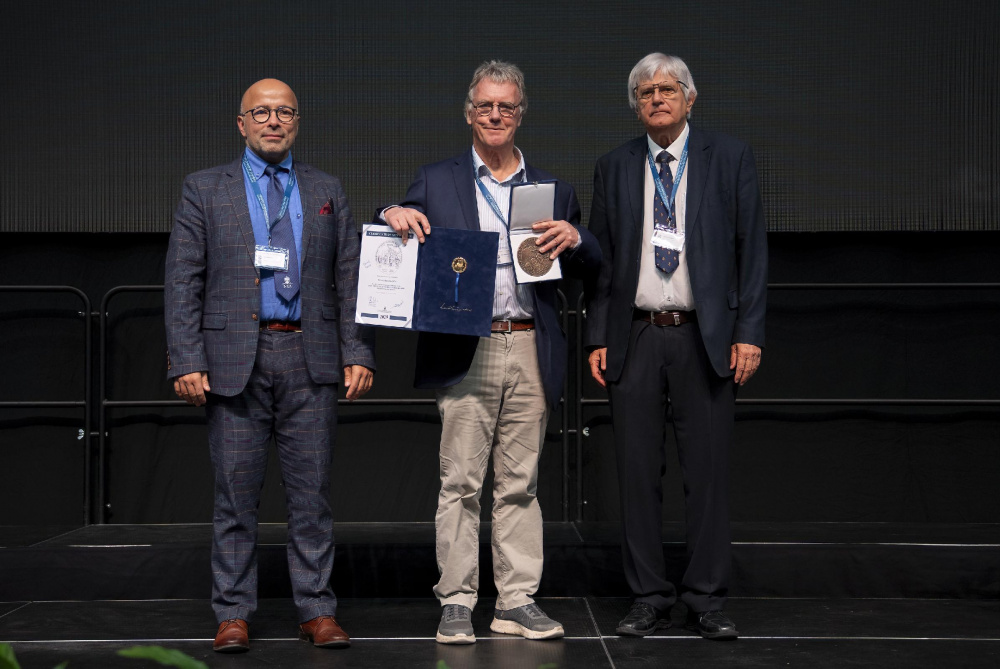
Following the Nobel Laureate’s lecture, the Szent-Györgyi Student of Excellence 2025 award was presented to Benedek Szathmári. The PhD student at the Biochemical Institute of the HUN-REN Biological Research Centre, Szeged has been participating in the National Academy of Scientist Education Program for six years, focusing his research on the evolution of fungal complexity and development. After receiving the award, he delivered a presentation on the same topic. After the lunch break, Shahrokh Shariat gave his lecture, which primarily focused on his research career, highlighting the pivotal moments that – intentionally or not – helped him advance to higher levels in the scientific field. As a closing highlight, guests had the opportunity to attend a special lecture by Péter Hegyi. In the presentation, the Professor offered insight into the journey for 25 years that led to the discovery of why the pancreas secretes bicarbonate. The topic was especially timely, following Péter Hegyi’s receipt of the Robert F. Pitts Award in September, in recognition of this outstanding research and its findings. His team demonstrated that pancreatic bicarbonate secretion is crucial for keeping digestive enzymes inactive within the pancreas, and only afterward does bicarbonate serve its role in neutralizing acid as it moves from the stomach into the intestines. Overall, this discovery has shed new light on pancreatic physiology and the progression of both acute and chronic pancreatitis.
Young researchers take the stage
After Péter Hegyi’s lecture, the Monday program concluded with a Gala performance and Gala dinner, paving the way for the final day of the conference on Tuesday. On that day, Szent-Györgyi Students and Pupils took part in a Roundtable discussion at the József Attila Study and Information Center, conducted in nine-person groups over two sessions, with more than 300 secondary school children’s participation. Peter Ratcliffe also joined one of the tables, much to the pupils’ delight. Meanwhile, in the building’s Congress Hall, outstanding Szent-Györgyi Students presented their research projects. Tamás Zsoldos gave his lecture about memory-regulating cells, while Kornél Molnár shared insights from his research on allergic skin diseases. Adél Lüvi then highlighted the role of astrocytes in the development of brain metastases. Miklós Lovas gave the next talk, titled Sugars against the flu: an introduction to targeted protein degradation, followed by Bálint Kisjós, who explained how micro-RNAs mediate the anti-tumor effects of regular exercise. The final presentation was delivered by Noémi Vida on the development of a large-animal model for kidney transplantation.
Although the NASE’s Szeged event ended on Tuesday, secondary school pupils from the ELTE Trefort Ágoston Practice Grammar School, who are members of the Scientist Training Program, could still meet the Nobel Laureate researcher in Budapest the next day. Peter Ratcliffe visited the school’s natural science laboratory to observe a NASE practice there as well. During this session, pupils dissected chicken wings and cow eyes, performed gel electrophoresis and chromatography. Throughout the lesson, the researcher also approached the children’s tables, and later joined a panel discussion in the school’s Ceremonial Hall alongside Péter Hegyi and András Varró. Additionally, the pupils also had the chance to gain insight into the nature of research work.